Definition
- The purpose of an airway assessment is to predict and plan for a difficult airway
- The definition of a difficult airway1 is: “the clinical situation in which a conventionally trained Anaesthesiologist experiences difficulty with facemask ventilation, difficulty in supraglottic device ventilation, difficulty in tracheal intubation or all three” where:
- Difficulty with facemask ventilation is the inability of an unassisted anaesthesiologist:
- to maintain oxygen saturation, measured by pulse oximetry, 92%; or
- to prevent or reverse signs of inadequate ventilation during positive-pressure mask ventilation under general anaesthesia
- Difficult laryngoscopy occurs when “it’s not possible to visualise any portion of the vocal cords with conventional laryngoscopy”
- This typically corresponds to a Cormack and Lehane Grade IV laryngoscopy view
- Difficult endotracheal intubation occurs when “proper insertion of the tracheal tube with conventional laryngoscopy requires more than three attempts or more than 10 minutes”
- Difficulty with facemask ventilation is the inability of an unassisted anaesthesiologist:
Pre-Operative Airway Assessment
History
- General history elements:
- Reason for airway protection/management
- AMPLE history (allergies, medications, past medical history, last meal, events)
- Exercise capacity
- Smoker
- Symptoms or risk factors for airway compromise:
- Stridor, hoarse voice, orthopnoea, drooling, dysphagia
- Risk factors - suspecterd airway burn, neck trauma, goitre
- Risk factors for difficult airway management: infections of oropharynx and neck (e.g. Ludwig’s angina), problems with mouth opening (e.g. trauma, soft tissue disorders), problems with neck mobility (e.g. cervical spine disruption, rheumatoid arthritis, cervical fusion), , Obesity, OSA, oropharyngeal or neck masses, dentition, pregnancy, recent intubation, angioedema, burns
Chart Review
- Whenever possible identify:
- The patient’s previous intubation grade and previous difficulties with airway management
- Determine what techniques and manoeuvres were required to optimise airway management conditions
Examination
- General
- Level of consciousness and co-operation
- BMI
- Face: facial hair, craniofacial deformities
- Mouth
- Mallampati grade
- Mouth opening (inter incisor distance)
- Shape of palate
- Jaw protrusion
- Teeth
- Teeth prominence
- Relaxation of maxillary to mandibular incisors during normal jaw closure
- Dentures/caps/grows/loose teeth
- Neck
- Range of motion of head and neck
- Thyro-mental distance <6cm
- Neck length and circumference/thickness
- Compliance of mandibular space
- Sternomental distance
Investigations
- Investigations to consider:
- Nasal endoscopy
- Awake laryngoscopy
- Lateral neck x-ray
- Chest X-ray
- CT/MRI neck
- Mallampati score
- Class I: Soft palate, uvula, fauces, pillars visible
- Class II: Soft palate, uvula, fauces visible
- Class III: Soft palate, base of uvula visible
- Class IV: Only hard palate visible
- Cormack-Lehane Classification
- Grade 1: Full view of glottis
- Grade 2a: Partial view of glottis
- Grade 2b: Only posterior extremity of glottis seen or only arytenoid cartilages
- Grade 3: Only epiglottis seen, none of glottis seen
- Grade 4: Neither glottis nor epiglottis seen

- Percentage of visible glottic opening (POGO)
- It requires the observer to estimate how much of the glottis is not visualised
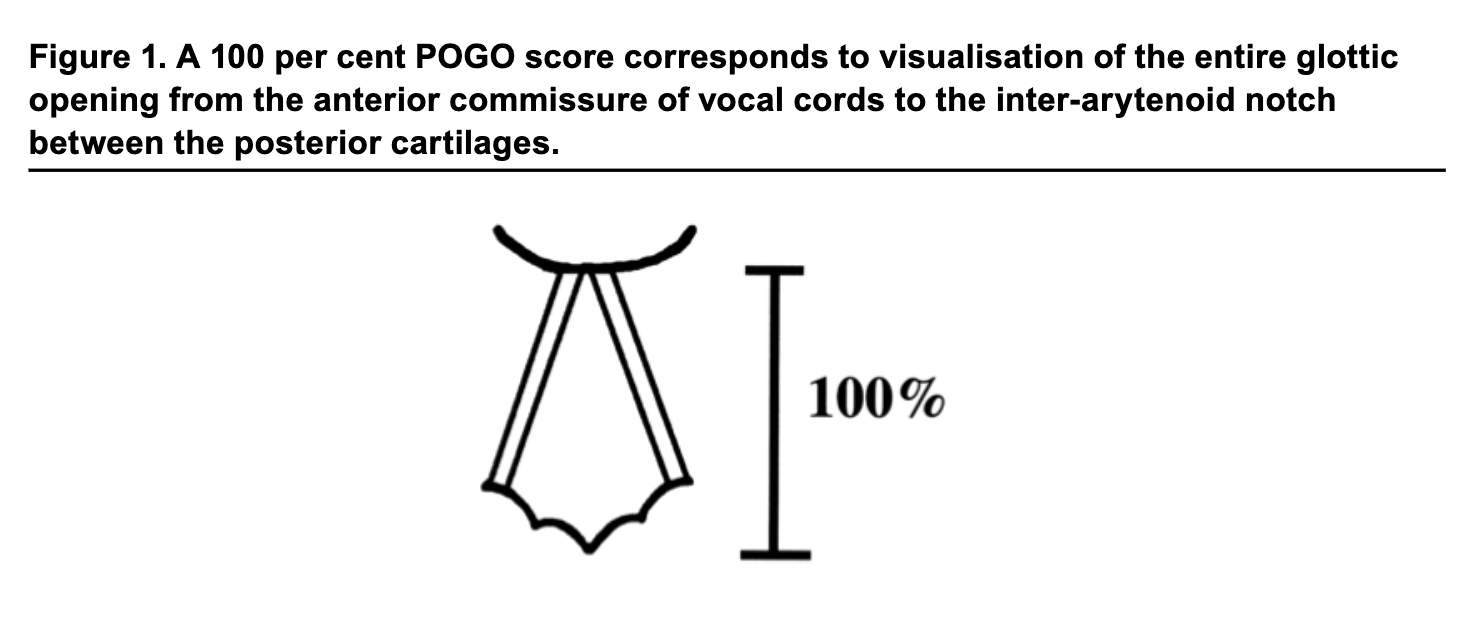
- It requires the observer to estimate how much of the glottis is not visualised
Mnemonics
- Difficult intubation = LEMON
- Look externally
- Evaluate 3-3-2 rule
- Mallampati score
- Obstruction
- Neck Mobility
- Difficult BVM = BONES
- Beard
- Obese
- No teeth
- Elderly
- Sleep Apnea / Snoring
- Difficult LMA = RODS
- Restricted mouth opening
- Obstruction
- Distorted airway
- Stiff lungs or c-spine
- Difficult surgical airway = SHORT
- Surgery
- Hematoma
- Obesity
- Radiation distortion or other deformity
- Tumor
Sources
- Airway Assessment • LITFL Medical Blog • CCC Airway - Chris Nickson - Updated July 1 2024 - Accessed 28 August 2026
- Airway Assessment - ANZCA - Bradley, P., Chapman, G., Crooke, B., Greenland, K August 2016 - Accessed 28 August 2026
Footnotes
-
More on the definition of the anatomically difficult airway can be read at Recognition of the anatomically difficult airway ↩